
7 Signs Your Business Needs Custom Software Development
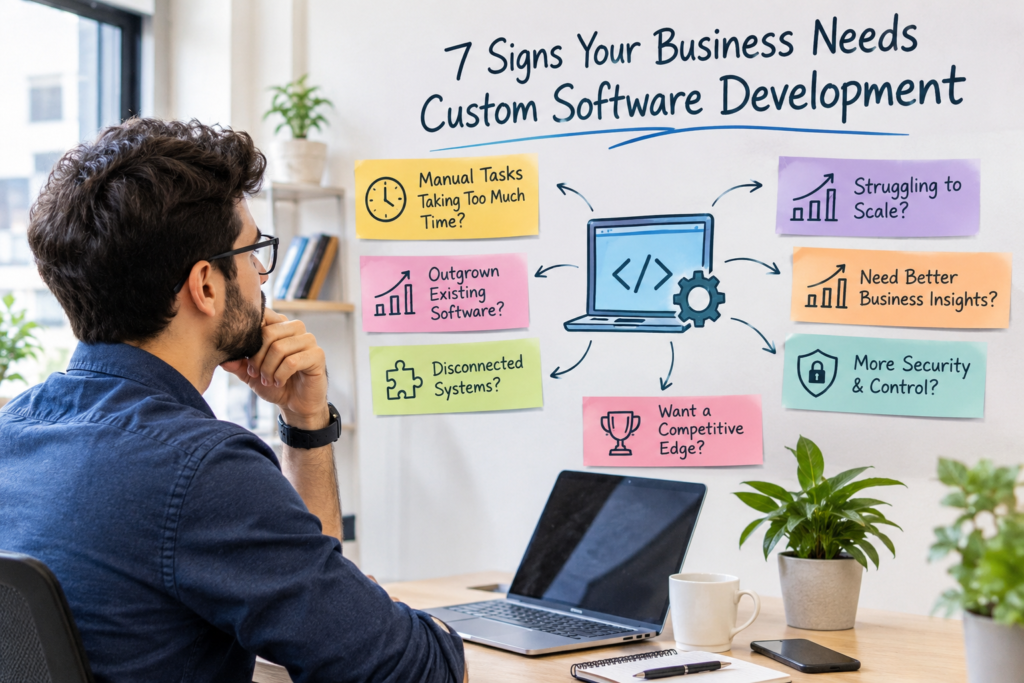
Every business wants to save time, manage operations smoothly, and serve customers better. However, as a company grows, its existing tools may struggle to keep up. Employees may spend hours on manual tasks, different systems may fail to work together, and business owners may find it difficult to track important information.
Custom software development helps businesses solve these challenges by creating software that matches their specific needs. Instead of relying entirely on standard tools, businesses can invest in applications designed around their workflows, goals, and future plans.
At WebBirth, businesses can explore software and application development solutions that support their digital goals. But how do you know when it is the right time to invest? Here are seven signs that indicate your business may benefit from custom software development services.
What Is Custom Software Development?
Custom software development is the process of building software to meet a business’s specific requirements. It focuses on solving particular operational problems rather than providing the same features to every user.
For example, a business may need software to manage customer enquiries, track inventory, automate billing, or connect multiple departments.
Custom software solutions can include:
Business management software: Organises daily operations and internal processes.
Customer relationship management (CRM): Helps manage customer details, enquiries, and follow-ups.
Enterprise resource planning (ERP): Connects business functions such as finance, inventory, and operations.
Workflow automation software: Reduces repetitive manual tasks.
Custom web and mobile applications: Provides specific services or features to employees and customers.
The main goal is to make business processes easier to manage and better aligned with company objectives.
1. Are Manual Tasks Taking Too Much Time?
If employees spend a significant amount of time completing repetitive tasks, your business may need a more efficient system. Manual work can slow down operations, increase the chance of errors, and prevent employees from focusing on important responsibilities.
Common warning signs include:
Entering the same information into multiple spreadsheets.
Preparing reports manually every week or month.
Sending customer reminders individually.
Updating orders or inventory across different platforms.
Managing approvals through long email conversations.
Custom software development can automate suitable tasks and reduce unnecessary work.
2. Has Your Business Outgrown Existing Software?
Ready-made software can be useful when a business starts operating. It usually provides standard features that are easy to implement. However, growing businesses may eventually need functions that their existing applications cannot support.
You may notice problems such as:
Limited customisation options.
Restrictions on users or business processes.
Difficulty adding new features.
Missing reports or specialised functions.
Expensive upgrades that still do not meet your needs.
When these limitations affect daily operations, it may be time to explore custom software development services. Before making the investment, check whether upgrading your existing software or adding an integration would solve the problem. If these options are insufficient, a tailored solution may provide a better fit for your business.
3. Are Your Business Systems Disconnected?
Many companies use separate tools for accounting, sales, inventory, customer management, and employee operations. When these tools do not communicate properly, information becomes scattered. Employees may need to enter the same details several times, while managers may struggle to obtain an accurate view of business performance. Custom software can connect different systems or bring important functions into a central platform.
This can help businesses:
Reduce duplicate data entry.
Improve information sharing between departments.
Maintain more consistent records.
Simplify reporting and daily coordination.
Depending on the problem, a targeted software integration may be sufficient. A complete custom application is worth considering when existing systems cannot support the required workflow.
4. Is Your Business Growing Faster Than Your Systems?
Business growth often means more customers, employees, transactions, and responsibilities. A process that works for a small team may become difficult to manage when the company expands. If your current software struggles to handle increasing workloads, custom development may help you prepare for the next stage of growth.
A scalable solution can be planned around requirements such as:
Increasing numbers of users and transactions.
New business locations or departments.
Additional services and product categories.
New integrations with third-party platforms.
More detailed reporting requirements.
For example, a growing logistics company may need software that connects order tracking, delivery schedules, customer updates, and internal reporting.
A custom system can be developed in stages, starting with the most important features. This approach helps businesses address current problems without investing in every possible feature at once.
5. Are You Struggling to Access Accurate Business Data?
Business owners need reliable information to make decisions about sales, costs, customer service, and operations. However, when data is spread across spreadsheets and separate applications, collecting and analysing it can become time-consuming. Custom software can organise relevant information and present it through dashboards and reports.
Depending on your requirements, these features may include:
Sales and revenue reports.
Inventory and order tracking.
Customer activity records.
Employee task monitoring.
Business performance dashboards.
Better access to information can support faster decisions. However, the software must use accurate data and appropriate reporting methods to provide meaningful results.
6. Do You Need More Control Over Security and Access?
As a business grows, it may need stronger control over how employees access company information. Not every employee needs access to every record. Financial information, customer details, internal documents, and management reports may require different permissions.
Custom software can be designed with features such as:
Role-based user access.
Secure login and authentication.
Activity logs and approval records.
Data encryption where appropriate.
Controlled access to sensitive information.
These features can help businesses manage information according to their operational needs. However, custom software is not automatically more secure than ready-made software. Security depends on proper development, testing, maintenance, and access management. Businesses handling sensitive data should identify their security and compliance requirements before development begins.
7. Do You Need Features That Competitors Cannot Easily Replicate?
Sometimes, businesses invest in custom software because they want to offer a service or experience that standard applications cannot provide. Custom software can support these requirements by providing features built around the company’s business model.
Before investing, consider these questions:
What problem do your customers experience?
Which existing features fail to address that problem?
How would a custom solution improve the customer experience?
Could the proposed feature support your business objectives?
Can the expected benefits justify the development and maintenance costs?
Custom software should solve a meaningful business problem. Building an application simply because other companies have one may not provide sufficient value.
When Should You Invest in Custom Software Development?
Recognising the warning signs is important, but businesses should also evaluate whether the investment makes financial and operational sense.
Before contacting a custom software development company, consider the following factors.
1. The problem occurs regularly. If a process repeatedly causes delays, errors, or unnecessary work, improving it may deliver lasting value.
2. Existing solutions are insufficient. Check whether a ready-made application, upgrade, or integration can meet your requirements before choosing a custom build.
3. The benefits can be measured. Identify outcomes such as reduced processing time, fewer manual errors, faster reporting, or improved customer response.
4. The budget covers long-term costs. Consider design, development, testing, deployment, hosting, maintenance, and future improvements.
5. Your team is ready to use the solution. Training and workflow changes are important for successful implementation.
Evaluating these factors helps you make a decision based on business needs rather than technology trends.
Is Custom Software Better Than Ready-Made Software?
The right choice depends on your business requirements, budget, and available resources.
| Factor | Custom Software | Ready-Made Software |
|---|---|---|
| Features | Designed for specific needs | Provides standard features |
| Initial investment | Often higher | Often lower |
| Setup time | Requires planning and development | Usually quicker |
| Flexibility | Can be adapted to requirements | Depends on available options |
| Integrations | Can be developed for required systems | Depends on supported integrations |
| Maintenance | Requires a planned support arrangement | Often partly managed by the vendor |
What Is the Custom Software Development Process?
Understanding the development process helps you plan the investment and set realistic expectations.
1. Requirement analysis: Identify business challenges, user needs, and essential features.
2. Planning and design: Define the project scope, software structure, integrations, and user experience.
3. Development: Build the application according to the agreed requirements.
4. Testing: Check functionality, performance, usability, and security.
5. Deployment: Introduce the software into the business and help employees understand how to use it.
6. Maintenance: Fix issues, apply updates, and introduce improvements as requirements change.
For many businesses, starting with a minimum viable product (MVP) is a practical option. An MVP includes the essential features needed to solve the main problem. Additional features can be developed later based on feedback and actual business needs.
How Do You Choose a Custom Software Development Company in Bangalore?
Choosing the right development partner is an important part of the investment. A suitable company should understand your business challenges before recommending a solution.
When evaluating a custom software development company in Bangalore, consider these points:
Relevant experience: Check whether the company has worked on similar software or applications.
Requirement analysis: Ensure the team understands your goals, users, and operational challenges.
Clear project scope: Discuss features, deliverables, timelines, and potential additional costs.
Testing and security: Ask how the team checks software quality and addresses security requirements.
Ongoing support: Clarify maintenance arrangements and how future improvements will be handled.
Ownership terms: Understand your rights to the source code, documentation, and developed software.
A clear development plan can help prevent misunderstandings and ensure the software remains focused on your business objectives. WebBirth offers web application, mobile application, and software development solutions for businesses looking to address their digital requirements. You can explore the WebBirth website to learn more about its services.
Conclusion:
Custom software development can be a valuable investment when existing tools cannot support your workflows, manual processes consume too much time, or your business needs specialised features to grow.
Start by identifying the problem, comparing available solutions, estimating the total cost, and defining how success will be measured. You may not need a complete software platform immediately; a focused application or phased development plan could address your most important requirements.
If your business is facing these challenges, WebBirth can help you explore software and application development options suited to your goals. The right solution should simplify operations, address real business needs, and support your company’s long-term growth.
Frequently Asked Questions
1. When should a small business invest in custom software?
A small business should consider custom software when manual tasks, growing workloads, or limitations in existing applications regularly affect productivity. The investment should fit the budget and solve a clearly defined problem.
2. How much does custom software development cost?
The cost depends on the features, complexity, integrations, design, security requirements, and maintenance needs. Request a detailed estimate based on your requirements rather than relying on a general price.
3. How long does custom software development take?
A simple application may take weeks or months, while a complex business platform can require considerably more time. The timeline depends on project scope, technical requirements, testing, and feedback.
4. Can custom software help a business grow?
Yes. Custom software can support growth by automating workflows, connecting systems, organising data, and providing features designed around changing business needs. Results depend on the quality and suitability of the solution.
5. Is custom software suitable for startups?
It can be suitable for startups with unique business requirements or product ideas. However, startups should compare development costs with ready-made options and consider starting with essential features before expanding the software.
6. Why should I hire a custom software development company in Bangalore?
A development company can help analyse requirements, plan the software, build the application, test its functionality, and provide support. Evaluate experience, communication, pricing, and technical capabilities before selecting a provider.